Aircraft Engine RUL Prediction AI
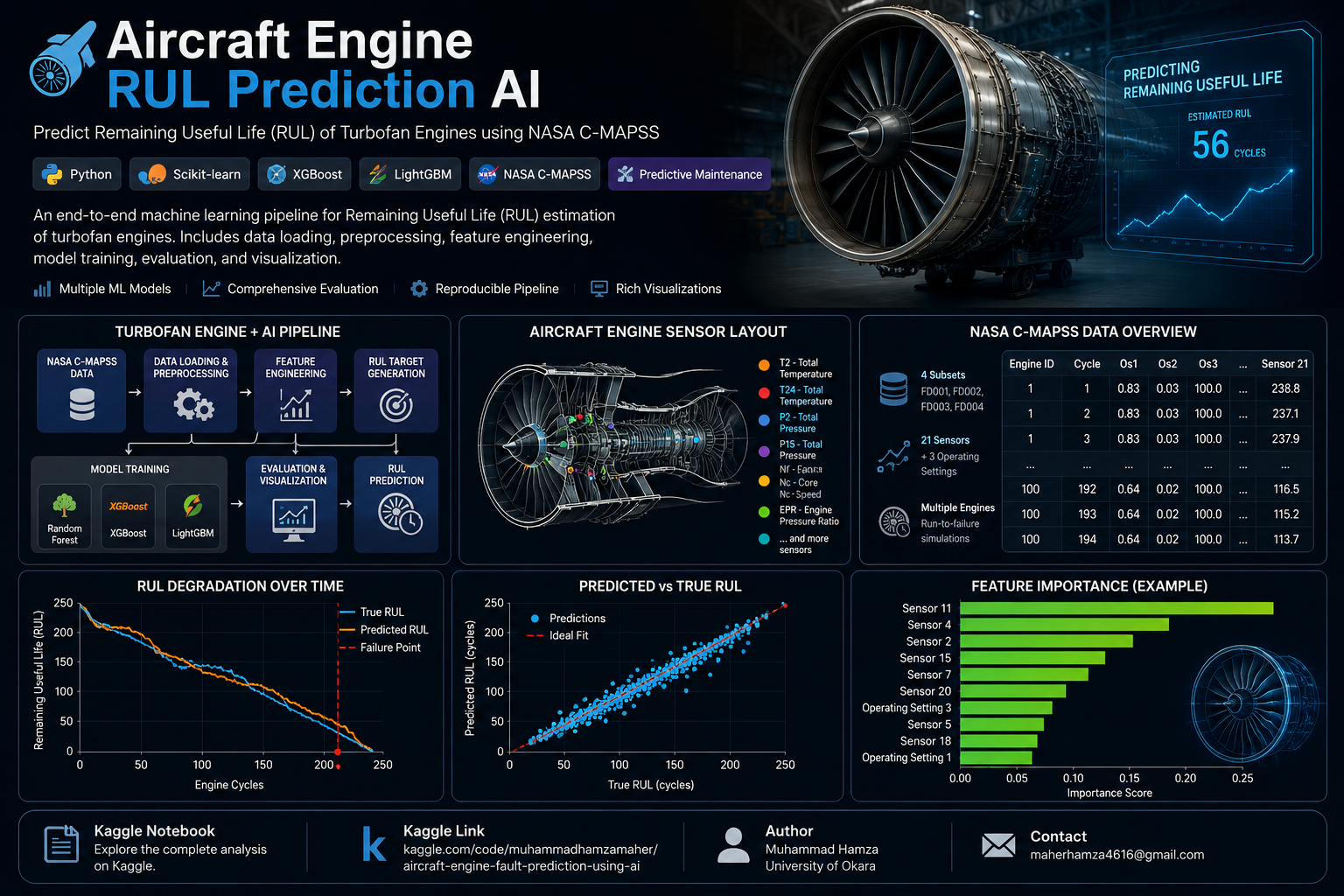
A predictive-maintenance system estimating the Remaining Useful Life of turbofan aircraft engines from NASA C-MAPSS sensor data.
Overview
This machine learning project estimates the Remaining Useful Life (RUL) of turbofan aircraft engines using NASA's C-MAPSS simulated degradation dataset. It demonstrates how multivariate sensor measurements and operational cycles can predict how many cycles remain before engine failure — enabling proactive maintenance planning instead of reactive repair.
Purpose — Why This Project Exists
Unscheduled engine failures are expensive, disruptive and dangerous, while fixed-interval servicing wastes good component life. This project shows how airlines can shift toward condition-based maintenance — using real sensor trends instead of a calendar to decide when an engine actually needs attention — by comparing several regression models on real NASA degradation data.
Animated Pipeline
Key Features
Benefits
Predicts failures before they ground an aircraft unexpectedly.
Condition-based scheduling avoids servicing parts that still have life left.
Three models compared side by side so the best performer wins.
Trained on authentic NASA run-to-failure engine trajectories.
Evaluation Metrics
RMSE (Root Mean Squared Error) and R² Score are used to measure prediction accuracy and how well each model explains RUL variation.